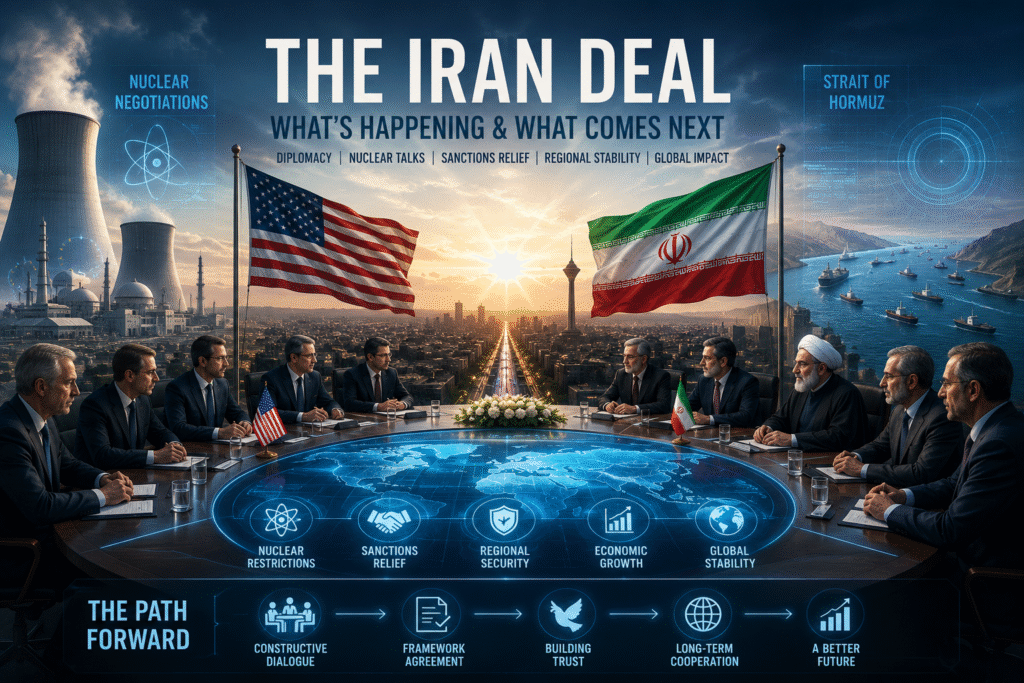
The Iran Deal:
What’s Happening,
Why It Matters
The US and Iran are on the edge of a historic agreement — one that could end a war, reopen a global energy chokepoint, and reshape the Middle East. Here’s everything you need to know.
- War began: February 28, 2026 (US & Israel strikes on Iran)
- Ceasefire declared: April 8, 2026
- Strait of Hormuz: Restricted since March 4, 2026
- Oil prices surged ~65% in a single month
- Mediators: Pakistan, Qatar, Turkey, Egypt
- Trump: Deal “largely negotiated” — May 23, 2026
How Did the War Start?
The conflict didn’t come out of nowhere. For years, tensions between the US and Iran had been building over Iran’s nuclear ambitions, its ballistic missile program, and its support for armed groups across the Middle East.
Indirect negotiations in early 2026 appeared to be making progress — but they collapsed. Trump said he was “not thrilled” with the pace of talks. What followed was swift and dramatic.
US and Israel launch coordinated strikes on Iran — targeting nuclear facilities, military infrastructure, and top leadership. Supreme Leader Ali Khamenei is killed.
Iran declares the Strait of Hormuz “closed.” Ships are attacked. Global oil markets go into shock.
A conditional ceasefire is declared, pausing major fighting. Peace negotiations begin, mediated by Pakistan and Qatar.
Trump announces a deal is “largely negotiated.” Iran’s foreign ministry describes it as a framework agreement. Key disputes remain unresolved.
Why Does the Strait of Hormuz Matter?
The Strait of Hormuz is a narrow waterway — about 30 miles wide at its tightest point — sitting between Iran and Oman. It doesn’t look like much on a map. But roughly 20% of the world’s daily oil supply flows through it.
When Iran shut it down in early March, the consequences were immediate and global. Oil prices surged by about 65% in a single month — the largest monthly rise ever recorded. The International Energy Agency called it the largest supply disruption in oil market history. Fuel shortages spread across parts of Asia. Inflation climbed in the US, Europe, and beyond.
The Federal Reserve flagged the disruption as a direct threat to price stability in the United States. Global GDP growth projections were revised downward. The World Bank estimated global oil output fell by nearly 7% year-on-year in the second quarter of 2026.
Where Do the Talks Stand Right Now?
As of May 23–24, 2026, negotiations are moving faster than at any point since the ceasefire. On Saturday, Trump announced on social media that a peace deal had been “largely negotiated” — involving the US, Iran, and several other countries. He said final details would be announced “shortly.”
Pakistan and Qatar have been the key brokers, with their negotiators holding direct talks with Iranian counterparts over the past week. Turkey, Egypt, and Gulf leaders are also involved. Trump is expected to hold a conference call with regional leaders to discuss the final shape of any agreement.
Iran’s Foreign Ministry described the emerging framework as a memorandum of understanding — a first phase, to be followed by broader negotiations over 30 to 60 days on Iran’s nuclear program.
But not everything is settled. Iran’s state media pushed back hard on Trump’s claim that the Strait would be freely reopened. Iran’s Fars News Agency said the Strait would remain under Iranian management — not “free passage” as it existed before the war.
Secretary of State Marco Rubio said there had been “some progress” but drew clear red lines: Iran cannot have a nuclear weapon, must give up its enriched uranium, and the Strait must be reopened without tolls.
What Would a Deal Actually Include?
Based on what both sides have said publicly, a framework agreement would likely include:
- 01 An official declaration ending the war
- 02 Reopening the Strait of Hormuz to international shipping
- 03 Unfreezing some Iranian assets held in foreign banks
- 04 A 30–60 day window for broader nuclear negotiations
- 05 A continuation of Pakistan/Qatar-led mediation during the transition
Iran’s nuclear program is the hardest issue. The US insists Iran must surrender its stockpile of highly enriched uranium. Iran wants to address this in a later phase rather than upfront. This gap is real, and it could still derail everything.
What Are the Alternatives if Talks Fail?
Resumed Military Action
Trump said it’s a “solid 50/50” between a deal and military strikes. Israel’s Netanyahu has pushed for resuming the war. If talks collapse, this is the most immediate risk.
Indefinite Ceasefire
The ceasefire holds but no peace deal is signed. The Strait stays partially restricted, oil markets remain volatile, and the conflict simmers without resolution.
Multilateral Push
Pakistan, Qatar, Turkey, and Egypt intensify mediation. The UN could also re-enter as a neutral facilitator if direct US-Iran talks stall.
Narrow Nuclear Deal
A limited agreement focused only on halting Iran’s nuclear program in exchange for sanctions relief — similar in spirit to the 2015 JCPOA that Trump abandoned in 2018.
The Human & Economic Cost So Far
The human toll has been severe. Thousands of people have been killed in Iran and Lebanon. Dozens more have died in Israel and the Gulf Arab states. Millions have been displaced across the region. The conflict also prompted a resumption of the Israel-Hezbollah war in Lebanon.
Economically, the damage is historic. Oil prices surged above $100 per barrel. Global GDP growth projections have been cut. Inflation has climbed across countries that depend on Gulf energy. The Dallas Fed estimated the Strait closure could lower global GDP growth by nearly 3 percentage points in Q2 2026 alone.
Your Questions, Answered
Clear answers to the most common questions about the Iran deal and the war.
The US and Israel launched strikes on February 28, 2026, after concluding that diplomacy had failed to contain Iran’s nuclear program and ballistic missile capabilities. Both governments described it as a preemptive act of self-defense. The attacks followed a breakdown in indirect negotiations, with Trump saying he was “not thrilled” with their progress. Iran had been advancing its nuclear enrichment levels significantly, raising concerns about how close it was to a weapons-grade capability.
As of May 24, 2026, a deal appears closer than at any previous point — but it is not final. Trump said a framework has been “largely negotiated,” while Iran described it as a memorandum of understanding covering phase one. Key disputes remain, particularly over the Strait of Hormuz and Iran’s nuclear program. Trump himself said it’s a “50/50” call between a deal and resuming strikes, so nothing is certain yet.
The Strait of Hormuz is a narrow sea passage between Iran and Oman. About 20% of the world’s daily oil supply passes through it. When Iran closed it in early March 2026, oil prices surged by roughly 65% in a month — the biggest monthly increase ever recorded. It triggered fuel shortages, inflation spikes, and a global economic shock. Reopening the Strait is central to any peace deal because it directly affects energy prices worldwide, including in the US, Europe, and Asia.
Iran’s publicly stated priorities include: an official end to the war, the unfreezing of its assets held in foreign banks, and a phased approach to discussing its nuclear program — meaning it does not want to give up its enriched uranium upfront. Iran also wants to maintain some form of control or management over the Strait of Hormuz, which is where a major disagreement with the US exists. Iran’s Foreign Ministry described any first-phase deal as a framework, with the bigger issues left to 30–60 days of further talks.
Secretary of State Rubio spelled out three core US demands: Iran must never have a nuclear weapon, Iran must surrender its stockpile of highly enriched uranium, and the Strait of Hormuz must be fully reopened — without tolls or Iranian management conditions. The US also sees any deal as needing to address Iran’s ballistic missile program over time. Trump has framed this as wanting a deal he can present as historic and decisive.
Pakistan and Qatar have been the primary mediators, with their negotiators traveling between Washington and Tehran. Pakistan’s Prime Minister Shehbaz Sharif congratulated Trump on his “extraordinary efforts to pursue peace.” Turkey and Egypt have also been involved, and Trump is expected to hold a conference call with Gulf leaders. Oman played a role in earlier, failed nuclear negotiations. The involvement of multiple regional powers reflects how much is at stake for the wider Middle East.
If talks break down, the most likely outcomes are: a return to active military conflict (Trump and Israel have both signaled this is on the table), or a prolonged ceasefire without a formal peace agreement. Either outcome keeps the Strait of Hormuz in dispute, oil markets unstable, and the broader Middle East in a tense standoff. A collapsed deal could also trigger another spike in global oil prices and accelerate inflationary pressure in the US and Europe.
The Strait of Hormuz closure has already pushed oil prices above $100 per barrel, which flows through to fuel costs, transportation, and essentially everything that moves on a truck or plane. The Federal Reserve has flagged this as a direct inflationary threat. The Dallas Fed estimated the disruption could cut global GDP growth by nearly 3 percentage points in a single quarter. If a deal reopens the Strait, markets expect a significant price relief rally. If it falls apart, prices could surge again.
The Joint Comprehensive Plan of Action (JCPOA) was a 2015 agreement between Iran and six world powers — the US, UK, France, Germany, Russia, and China. Under it, Iran agreed to limit its nuclear enrichment activities in exchange for the lifting of international sanctions. Trump withdrew the US from the deal in May 2018, calling it inadequate, and reimposed sweeping sanctions. Iran gradually stopped complying with its limits, advancing its enrichment program significantly in the years that followed — which is part of what led to the current crisis.
Israel’s Prime Minister Netanyahu is deeply skeptical of any deal. Reports from Axios describe a tense call between Trump and Netanyahu, with one source saying Netanyahu’s “hair was on fire.” Israel wants to resume military action to further degrade Iran’s capabilities and weaken its military. Netanyahu has pressed Trump not to accept a deal he sees as leaving Iran’s core threats intact. Trump told reporters the call with Netanyahu “went very well,” though the disagreement over a diplomatic vs. military path appears real and ongoing.